



The continued expansion of advance care planning data elements in USCDI reflects healthcare's ongoing shift toward treating patient preferences as core clinical information
By Maria D. Moen, Senior Advisor, MyDirectives
The Office of the National Coordinator for Health Information Technology (ONC) recently released United States Core Data for Interoperability (USCDI) Version 7, expanding the standardized health information that certified electronic health record technology (CEHRT) systems should be able to access, exchange, and use electronically.
While each new version of USCDI expands the nation's interoperability framework, Version 7 carries particular significance for advance care planning (ACP). The continued inclusion and refinement of ACP-related data elements reflect a broader shift in healthcare: a person’s healthcare wishes are increasingly being recognized as foundational clinical information that should be available wherever care is delivered.
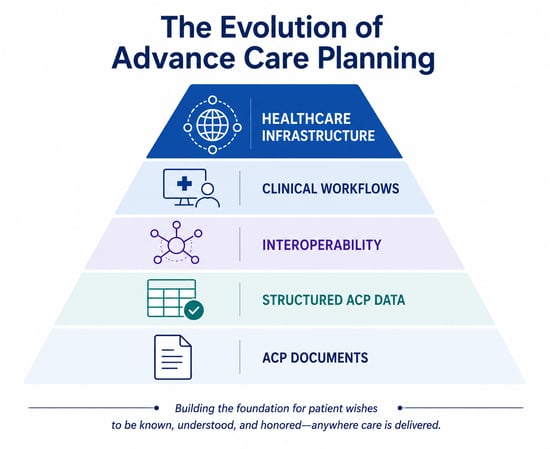
Digital ACP capabilities shouldn’t be viewed as simply another feature that adds to clinician burden or electronic health record complexity. They are healthcare infrastructure. By adding designated healthcare agent information to a growing set of interoperable ACP data elements, including treatment intervention preferences, care experience preferences, advance directive, DNR orders, and portable medical orders (e.g., POLST forms), USCDI Version 7 reinforces the expectation that this information should be exchanged as structured clinical data rather than managed as static documents.
From Documents to Interoperable Data
For many years, advance healthcare directives were treated primarily as documents. They were scanned into electronic health records, attached to a patient chart, and, when available to the healthcare provider, could be stored for future reference within the EHR's document repository. While these documents were often available for reference, the information they contained was largely inaccessible to clinical workflows, decision support, and even to other care teams treating the patient.
While electronic document storage represented an important step forward from paper documents stored in a shoe box or a filing cabinet, it also has inherent limitations. Information that cannot be readily found, exchanged, or incorporated into clinical workflows cannot consistently support informed clinical decision-making.
USCDI continues to advance a different vision by defining standardized data classes and elements that enable interoperable health information to move across systems nationwide in meaningful ways.
Among the ACP-related elements included in Version 7 are:
-
Healthcare Agent
-
Treatment Intervention Preference
-
Care Experience Preference
-
Advance Directive Observation
-
Portable Medical Orders
Collectively, these data elements recognize that clinicians and care teams need more than access to scanned documents. They need structured, machine-readable data, along with metadata that identifies the source of the information, the date it was created or voided, and the version of the specific form, all of which can be exchanged between systems, interrogated and interpreted by systems, incorporated into workflows, and made seamlessly available precisely when critical decisions are being made.
Interoperability Is the Real Challenge
Capturing ACP information is only the first step. By itself, without the promise of access to that information to inform care when it is intended to do so, it is a step that fails to deliver on the promise made to those for whom that information was captured.
The greater challenge is ensuring that individual preferences are available whenever and wherever care is delivered, whether in a hospital, physician’s office, skilled nursing facility, hospice, EMS agency, or another care setting.
For technology vendors, the message is clear: advance care planning is no longer just about storing and displaying documents created anew with each encounter or episode of care. USCDI reflects an industry-wide shift toward structured, interoperable ACP information that can be discovered, exchanged, verified as current, and incorporated directly into clinical workflows across healthcare settings.
As interoperability continues to mature, healthcare organizations need infrastructure that makes ACP information discoverable, exchangeable, verifiable, and clinically actionable across the healthcare ecosystem.
Why This Matters
Each successive version of USCDI expands the industry's shared expectations for nationwide interoperability.
The inclusion of ACP-related data elements reflects a growing recognition that individual preferences, goals of care, and values-based priorities for treatment are fundamental clinical information. This information belongs alongside medications, allergies, laboratory results, and other data clinicians rely on every day to make informed decisions.
For healthcare providers, EHR developers, HIEs, payers, and public health organizations, this represents both an opportunity and a responsibility. Supporting ACP is no longer simply about storing documents; it is about enabling trusted, standards-based exchange of structured clinical information across organizations and care settings.
How MyDirectives Supports This Evolution
MyDirectives was built to help healthcare organizations operationalize ACP as interoperable clinical data rather than isolated documents.
Our platform supports this through:
-
MyDirectives for Clinicians™ (MyDC), a clinical application that enables providers to create, access, and manage ACP information when and where healthcare decisions are made, whether as a standalone solution or integrated with EHR and ePCR systems
-
Production integrations with Epic, Oracle Health, MEDITECH, PointClickCare, KanTime, and a growing list of other leading EHR and ePCR systems bring ACP directly into clinicians' and ACP facilitators’ existing workflows
-
The A|D Vault Exchange™, the nation’s largest ACP document registry, provides nationwide access and interoperability through Carequality, CommonWell, eHealth Exchange, regional and statewide HIEs, and participating EHRs
-
Structured document management of healthcare agent designations, advance directives, advance care plans, and portable medical orders in multiple formats to meet systems and requesters where they are
-
Standards-based APIs that enable secure exchange of ACP information across healthcare organizations
As healthcare continues a steady advance toward nationwide interoperability, healthcare providers will increasingly need solutions that do more than create and store documents from inside their own setting. They will need infrastructure that ensures individual goals of care and treatment preferences are available wherever and whenever they are needed.
USCDI Version 7 is another important milestone in that evolution. It reinforces a future in which advance care planning is managed not as isolated documents, but as interoperable clinical data that supports informed clinical decision-making and coordinated care centered on the voice of the individual. Most importantly, it helps ensure that care is truly aligned with what matters most to each person receiving that care.
About the Author Maria D. Moen is Senior Advisor at MyDirectives and a nationally recognized leader in healthcare interoperability and advance care planning. With more than 25 years of leadership experience in health information technology, long-term and post-acute care, and healthcare operations, she is a passionate advocate for using technology and standards-based interoperability to improve person-centered care. Maria serves as Co-Chair of the HL7 Patient Empowerment Work Group and leads HL7 standards development projects focused on making advance care planning information interoperable across care settings. A Certified Advance Care Plan Facilitator, she is dedicated to ensuring every person's healthcare goals, values, and preferences are available to inform care whenever and wherever they are needed.




Secure, Interoperable, Accessible.
MyDirectives offers the only digital advance care planning (ACP) tools and interoperable cloud-based storage that is HITRUST Risk-Based 2-year Certified.